AI Literacy · Human-Computer Interaction · Public Health

Juan
Gabriel
Rodríguez

Manager, AI Literacy & Adoption at the Alzheimer's Association. I spearheaded the enterprise AI rollout to more than 1,600 staff, reaching 68% daily active users in three months, one of the fastest customer adoptions Anthropic has seen.

AI Literacy Human-Computer Interaction Public Health
Juan Gabriel Rodríguez
1,600+
Staff Trained on AI
68%
Daily Active Users in 3 Months
80%
Monthly Active Usage

Where public health meets human-centered AI

I'm a bilingual public health professional at the Alzheimer's Association in Chicago, where I lead AI Literacy & Adoption for more than 1,600 staff nationwide. I built the enterprise AI program from the ground up, from C-suite training to frontline workflows, agents and automation, and an Innovation Center of Excellence that moves ideas from intake to organization-wide rollout. My work sits at the intersection of communications, workforce training and responsible technology.

I hold a master's in Human-Computer Interaction from DePaul University and have spent a decade working across memory care operations, crisis helplines and public health communications. The through-line is technology adoption: before AI, I led an electronic health records implementation across a region of continuum-of-care communities, training frontline caregivers to work a new system into daily care.

AI Literacy & Adoption Change Management HCI & UX Public Health Comms Editorial Leadership Bilingual (EN/ES) Dementia Care EHR Implementation Workforce Education Responsible AI AI Agents & Automation Executive AI Training Center of Excellence
  • Spearheaded the enterprise AI rollout to more than 1,600 staff: 68% daily active users in three months, 80% monthly active usage.
  • Built training for every level, from the C-suite to frontline staff, in partnership with Anthropic and OpenAI.
  • Stood up a 58-person AI Black Belt peer network across five Labs, an Innovation Center of Excellence, and a skills-governance framework that gives staff room to build within clear guidelines.
  • Launched a repeatable training-video pipeline (90-second tips and sub-10-minute deep dives) and shared Claude skills that carry the Association's voice into daily work.
  • Led communications for the Healthy Brain Initiative, a CDC cooperative agreement promoting the HBI Road Map to state, local and tribal health departments.
  • Grew the Alzheimer's Public Health E-News from under 4,000 to more than 10,000 subscribers with 60%+ open rates.
  • Planned national webinars reaching 900+ participants each and coordinated presence at APHA, SOPHE, NACCHO and AAIC.
  • Helped manage budget and compliance for an $11 million federally funded program, and built a 178-resource public health library.
  • Served on the internal AI workgroup and built the first AI-assisted research and content workflows, the path into AI adoption.
  • Supported families and people living with dementia around the clock, maintaining 91% customer satisfaction.
  • Provided Spanish-language support and helped onboard and train new agents.
  • Managed a 40-bed memory care unit and supervised 20 care and engagement staff.
  • Delivered dementia training to community staff across the Chicago market.
  • Directed daily operations and led a team of 40 caregivers, med techs and activity aides.
  • Led the company-wide rollout of electronic health records, call-light and health-monitoring apps, including training and best practices. My first enterprise technology adoption, a decade before AI.
  • Capstone: "10 Healthy Habits for Brain Health," an e-learning module for older adults.
  • The design and learning-science foundation behind every training in the AI program.
  • Two degrees completed together in 2015: a Bachelor of Healthcare Administration with a concentration in Aging Services, and a Bachelor of Arts in Spanish.
  • The combination set the direction for everything since: health systems and aging on one side, bilingual communication on the other.

Bringing enterprise AI to a national nonprofit, one human at a time

In April 2026 I stepped into a new role: lead AI literacy and adoption for the Alzheimer's Association, a national nonprofit with more than 1,600 staff across chapters, research, care and support, advocacy and operations. Within three months we launched enterprise AI organization-wide, reached 68% daily active users and 80% monthly active usage, stood up 58 AI Black Belts as peer experts across every division, and built training that put people first and tools second.

Anthropic called it one of the fastest customer adoptions it has seen. The adoption held because the program showed each team what became possible in their own work: training built in partnership with Anthropic and OpenAI for every level from the C-suite to frontline staff, agents and automations that transformed roles, and an Innovation Center of Excellence that turns staff ideas into organization-wide rollouts.

Juan Gabriel Rodríguez
68%
Daily active users within three months
80%
Monthly active usage across 1,600+ staff
58
AI Black Belts: peer experts in every division
$2M+
Return on investment, thousands of hours redeployed to mission work

A human-first approach to AI training

01
Capability expansion, not time savings
"Look how much time you'll save" triggers workload anxiety. Every session and every staff demo was framed around what becomes possible in your role instead, and the result was more than $2 million in return on investment and thousands of staff hours redeployed to mission work.
02
AI Black Belts in every division
58 AI Black Belts are peer experts embedded across every division of the organization. Organized into Content, Field, Numbers, Mission and Policy/Enablement Labs, they learned first, identify AI workflows inside their own teams, mentor colleagues one on one, build and test agents, and carry staff ideas into the Innovation Center of Excellence.
03
Trust is dual
Building human trust across divisions and building trust in AI reinforce each other. Facilitation was designed around both, with responsible-use guidelines and a data retention policy in place before launch.
04
Every level, from the C-suite down
Executive sessions for senior leaders and the C-suite, cohort labs for champions, and short-form video for all staff, developed in partnership with Anthropic and OpenAI so training matched how the tools actually work.
05
Transform the role, not just the task
Worked with teams to redesign workflows and build AI agents and automations that return time to mission work, then routed the best ideas through an Innovation Center of Excellence from intake to prototype to rollout.
06
Grounded in learning science
Curriculum built on the 4D framework (Delegation, Description, Discernment, Diligence) and Bloom's Taxonomy, with spaced repetition, worked examples and scenario-based practice, informed by my HCI background and change management models like ADKAR.
Juan at DePaul commencement
M.S. in Human-Computer Interaction, DePaul University, 2025. The degree behind the design of every training in this program.

Change management: earning trust before scale

Adoption held because the rollout was treated as an internal change-management effort first and a technology launch second. The pattern, in the order it mattered:

Listen
Start with what people actually worry about
Discovery interviews and a baseline survey before any training. The real blocker was trust in accuracy and reliability, not fear of being replaced, which ranked last. The program was designed around verification and judgment from day one.
Segment
Meet each group where it is on the change curve
Leaders, early adopters and skeptics were at different stages, so messaging was deliberately segmented. Ethical and environmental questions were answered head-on with honest, shared talking points so every manager gave the same answer.
Frame
More room to do what only you can
Training was positioned as an enabler rather than another mandate, with honest expectations about the time it takes and that learning is continuous. The question in every session was what becomes possible in your role, never how many hours you will save.
Guardrails
Guidelines before access
Usage guidelines, a data-retention policy and a short required learning path were in place before the tools arrived, so trust was built into the rollout rather than added after.
Peers
Credibility from colleagues, not from the top
Black Belts demonstrated real workflows from their own teams at the all-staff launch, and access expanded in concentric circles around each champion before it went organization-wide.
Time
Protected, hands-on time beats drop-in
Scheduled lab and jumpstart sessions with dedicated working time reached 77% engagement; open office hours alone reached 11%. Blocked time was treated as part of the design, not an afterthought.
Loop
Keep listening after launch
Office hours, post-training interviews and an intake form turned repeat questions into FAQs and reusable assets. Champion sentiment moved from an NPS of +17 to +70 across the first wave.

How we built AI enablement at every level

The program was designed as a peer network with a framework around it: leaders sponsor, Black Belt Labs build and review, and every staff member can experiment, all inside the same usage guidelines and governance. Autonomy was the point; the framework is what made it safe to give.

Leaders
Sponsor and sign off
Executive sponsors with C-level blessing give each Lab visibility and a clear "yes." A town hall, FAQ and talking points so every manager could explain the why in their own words.
Labs
58 Black Belts, five Labs
Content, Field, Mission, Numbers and Enablement. Peer experts who learned first, run monthly sessions with rotating facilitators, review their division's skills, and mentor colleagues one on one.
Crowd
Every staff member builds
1,600+ staff with the fluency module, short videos and the freedom to create their own skills and projects, bounded by the AI Usage Guidelines rather than by approval queues.
Governance in proportion to reach
Tier 1 · IndividualUngoverned by design. Staff build and share skills one to one. No form, no review; just the guidelines. This is where nearly every good skill begins.
Tier 2 · Team & divisionReviewed by the Lab. Delivered as plugins to existing groups after a security check, a functional check and manual testing by the people who know the work.
Tier 3 · Organization-wideGoverned by the AI Collective. Intake form, review board, version history, and the Innovation Center of Excellence from prototype to rollout.

Reach is what triggers governance, not the act of building. Light where risk is low, structured where reach is high.

Work examples from the program

Internal materials are shown blurred on purpose; the icons say what each one is.

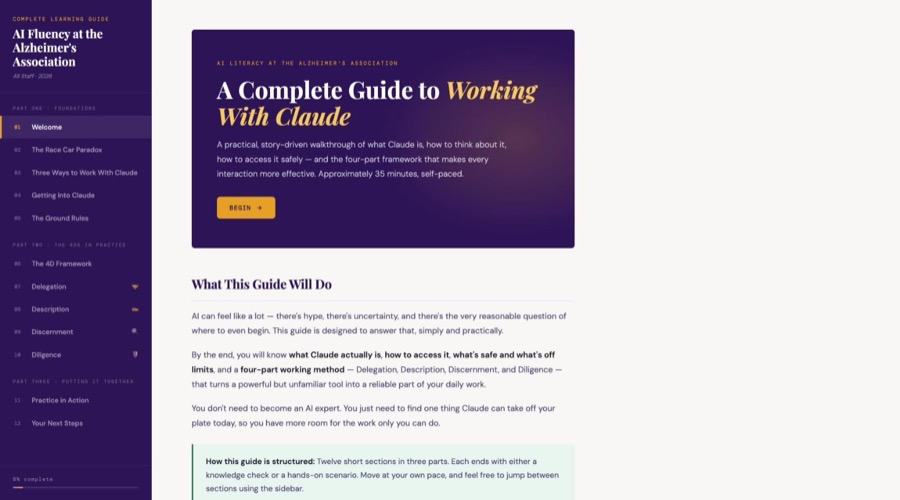
AI Fluency learning guide, opening screen
E-Learning · All Staff
AI Fluency Module
13-section, story-driven interactive module in the Association's brand system, with spaced repetition, scenario practice, a mid-module checkpoint and a Personal Action Plan wizard.
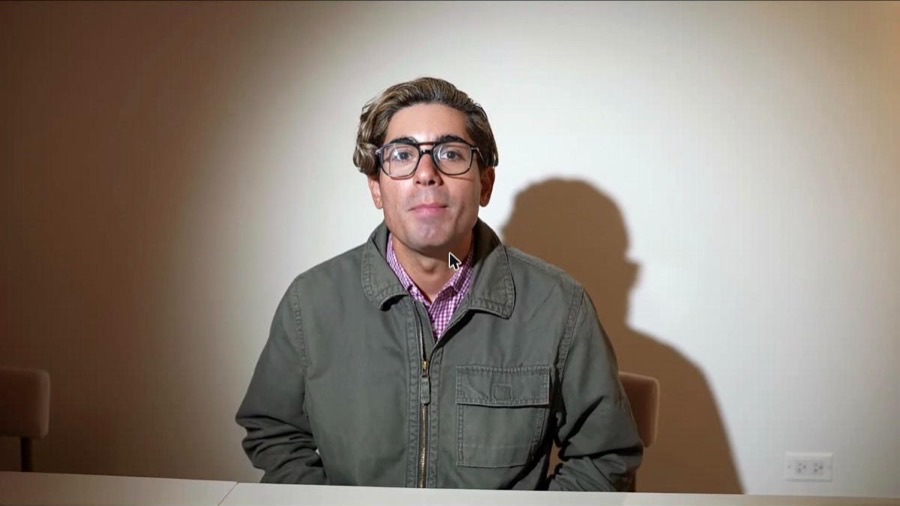
Juan presenting an AI training video
Video Series · On camera
How to Use Claude: Projects, Skills & M365
Organization-specific training I present on camera: 90-second highlight tips and sub-10-minute deep dives on connecting Claude to Outlook, Teams and OneDrive, building Projects and creating reusable Skills. A repeatable pipeline that scales training beyond live sessions.
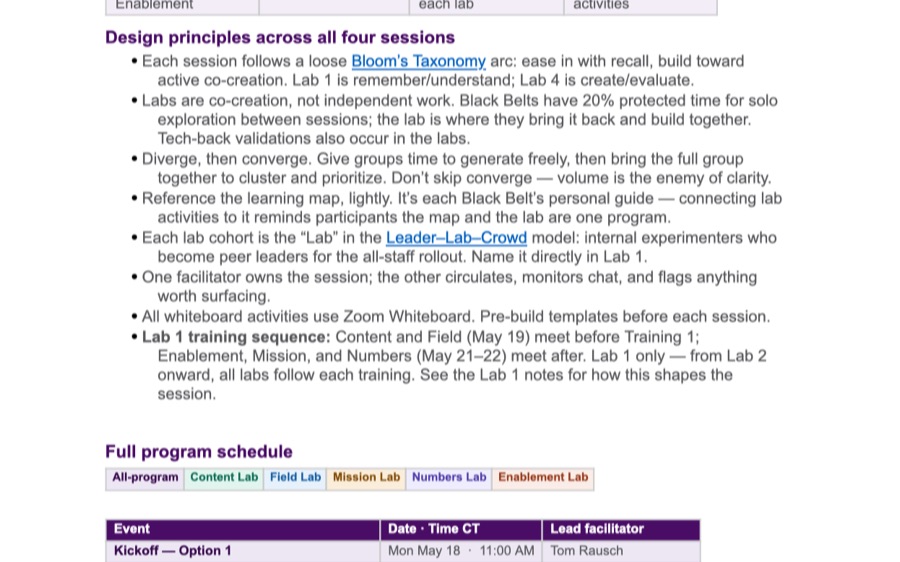
Lab facilitator guide for the AI Black Belt program
Peer Network · AI Black Belts
Black Belt Labs, Facilitator Model & Mentoring
Four-session lab arc built on Bloom's Taxonomy that turned 58 peer experts into mentors for their divisions, with two rotating facilitators per Lab and executive sponsors. Wave 1: 77% engagement, 34+ working assets, 16 Demo Day use cases, and an NPS that moved from +17 to +70.
Expert Curriculum
Five-Day "How Claude Works" Course
Standalone deep-dive for power users, plus a lab-organized thought leaders directory with a print-ready cohort handout.
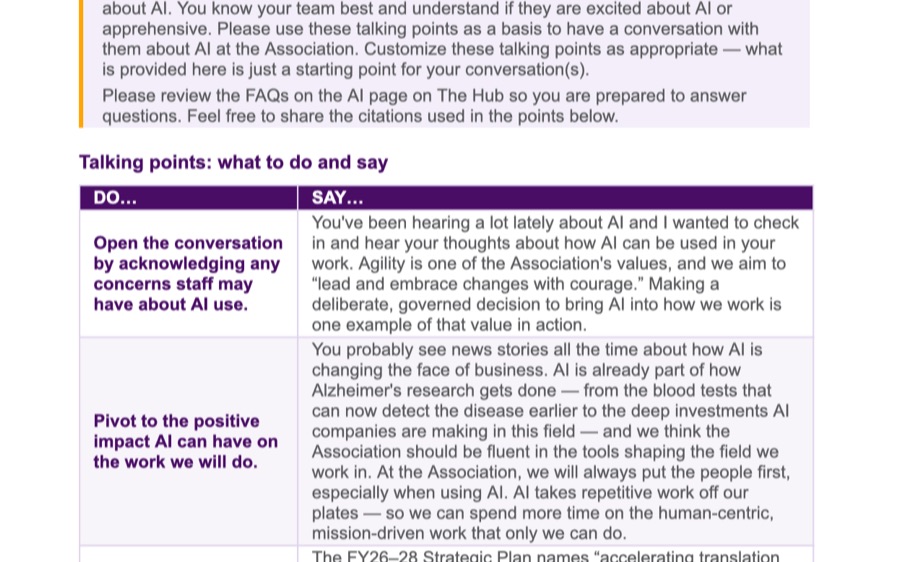
AI talking points guide for people leaders
Leadership Communications
Town Hall Deck, FAQ & Leader Talking Points
An all-staff town hall with live champion demos, a staff FAQ, and a leader talking-points guide so every manager could explain the why in their own words and acknowledge concerns before pivoting to what becomes possible.
Skill library executive summary document
Framework & Governance
Skills Framework & Innovation Center of Excellence
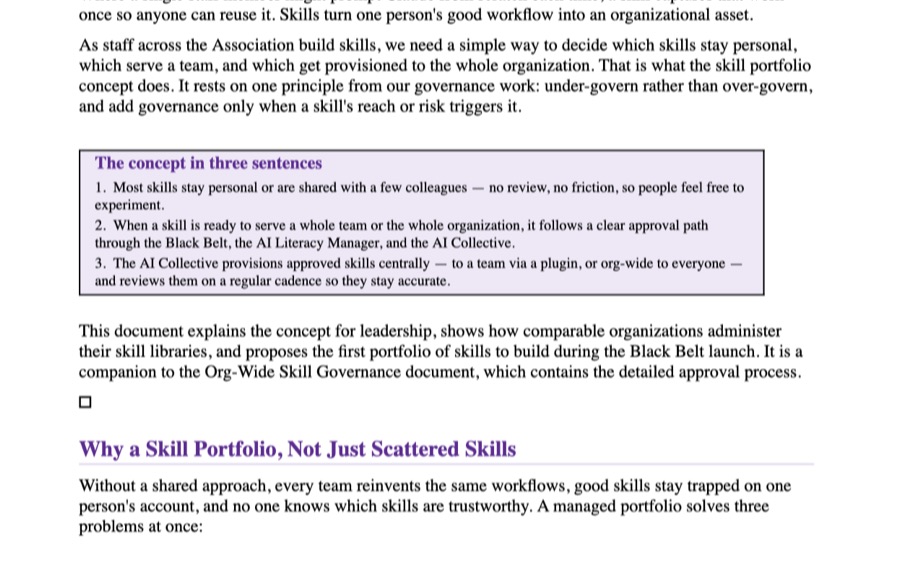
Three-tier skills framework approved through the AI Steering Committee: individual skills stay ungoverned, team skills ship as plugins after Lab review, org-wide skills pass the AI Collective. Intake form, security and functional checks, version history, and a pipeline from staff idea to organization-wide rollout.
AI usage guidelines five-minute video script
Responsible AI · Guardrails first
Usage Guidelines & Skills Policy
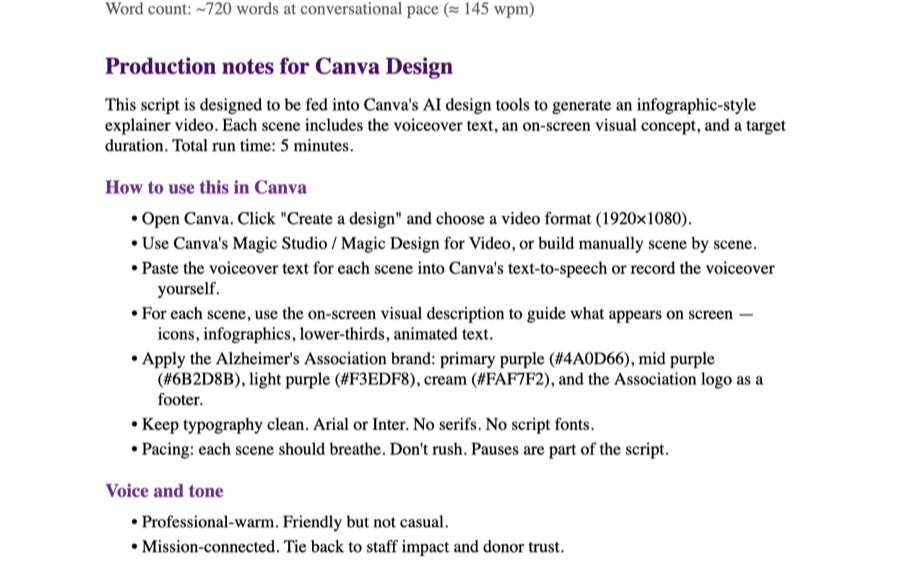
A five-minute usage-guidelines explainer, an AI Skills policy and a data-retention policy draft, in place before launch. Clear boundaries are what made it safe to give staff real autonomy with the tools.

Selected work & projects

Newsletter · Lead Editor
Alzheimer's Public Health E-News
Monthly newsletter for 10,000+ state, local, and tribal public health professionals. Grew from under 4,000 subscribers with a 60%+ open rate through content strategy, UX updates, and AI-assisted production.
Policy · Framework
HBI Road Map, 4th Edition
Contributed to multi-sector collaboration producing the 4th Healthy Brain Initiative Road Map, a national framework guiding public health action on dementia for state and local health departments.
AI · Workforce Development
AI Literacy & Adoption Program
Enterprise AI rollout to 1,600+ staff with 68% daily active users in three months, 58 AI Black Belt peer experts, $2M+ in return on investment, and an Innovation Center of Excellence.
Program · Communications
Healthy Brain Initiative (HBI)
Led communications and marketing for the CDC-funded HBI program, including the $11M BOLD Infrastructure for Alzheimer's grant — supporting state and local public health capacity for brain health.
Publication · The Gerontologist 2025
Expanding Public Health Capacity to Address Dementia
Co-authored peer-reviewed article in The Gerontologist on the HBI's role in building state and local public health capacity for dementia prevention and caregiving.
Press Feature · Block Club Chicago
Quoted: Delivery Robots & Community Consent
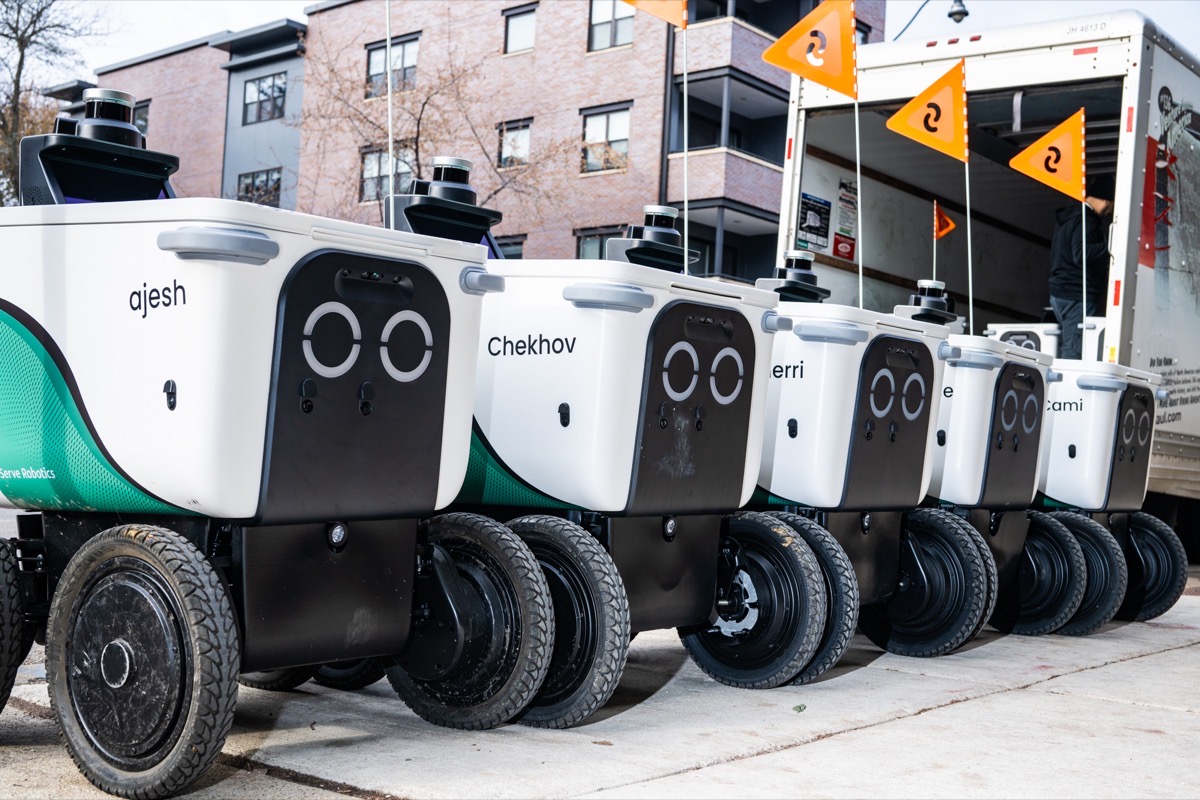
Featured in Block Club Chicago's investigation into delivery robot deployment, raising questions about accessibility, community input, and who controls public sidewalks.

Amplifying community voices on technology

Speaking up when technology deployment outpaces community consent, from Chicago sidewalks to public health AI adoption.

A sidewalk delivery robot in Chicago
Photo: Colin Boyle / Block Club Chicago
Block Club Chicago · Dec 8, 2025

Delivery Robots Take Over Chicago Sidewalks, Sparking Debate And A Petition To Hit 'Pause'

"What other corporations are we going to allow on our sidewalks? That's the last place that was meant to be human-centric. I don't want to lose that access and give open road for corporations to now start using our sidewalks."
"The companies have parachuted into Chicago communities without an understanding of, or a desire to learn, neighborhoods' specific needs."

Quoted in Block Club Chicago's investigation into the rollout of Coco and Serve Robotics delivery bots across Chicago neighborhoods — raising concerns about ADA accessibility, lack of community input before deployment, and the precedent of ceding public sidewalks to corporate interests.

December 8, 2025 · By Quinn Myers & Colin Boyle, Block Club Chicago

Read the Full Article ↗

Research & conference work

Peer-reviewed articles, conference presentations, and edited publications advancing the public health approach to brain health.

Webinars & conference talks

Sessions on brain health, public health workforce development, and dementia prevention, reaching hundreds of public health professionals nationwide.

What I'm thinking about

Live posts from my LinkedIn profile. To feature a different post, replace one of the post IDs in the list below (right-click any LinkedIn post, choose "Embed this post", and copy the number after activity:).

Follow my work on LinkedIn

I write about AI literacy, human-computer interaction and public health: what it takes to bring thoughtful technology into mission-driven organizations, and to keep people at the center of it.

Connect on LinkedIn
Topics I write about
AI Literacy Human-Computer Interaction Public Health Responsible AI Brain Health Workforce Development
See all posts on LinkedIn →

Let's connect

Whether you're working on public health communications, responsible AI adoption, or brain health initiatives, I'd love to talk.